A prospect is deciding between two coaches. Same niche, similar experience, prices within a few hundred dollars of each other. One sells "twelve sessions of one-to-one coaching." The other sells "twelve sessions — each one recorded, transcribed, and delivered to a private folder that's yours to keep." Which one feels like more?
The work might be identical. But one offer is a promise, and the other comes with something the buyer can picture holding. That difference is worth money — it's how the second coach charges more for the same hours — and it costs almost nothing to provide.
Why intangible work is hard to price
Coaching is intangible. You sell a transformation that happens in conversation, and the buyer can't inspect it before they pay — they're buying a promise. In a classic Harvard Business Review essay, marketing professor Theodore Levitt argued that when you ask customers to buy promises, you have to give them tangible reassurances of quality — the cues people reach for when they can't hold the thing itself. It's why service businesses lean so hard on the physical signals around the work: the bound report, the welcome kit, the polished follow-up.
A session recording is the most natural tangible cue a coach has, because it isn't a prop bolted onto the offer — it is the work, captured. An hour of focused, one-to-one attention, preserved in a form the client can replay, search, and return to. When you hand that over, the intangible suddenly has an artifact attached to it. The buyer stops trying to value thin air and starts valuing something they can see — which is exactly the shift that lets you name your rate with confidence.
This is the pricing-and-positioning side of a reframe we make in detail elsewhere: that the recording is the client's asset, not your filing problem. That post is about what clients do with a replay. This one is about what the artifact does to your offer.
Use the deliverable to charge more for coaching
Vague value is hard to charge for; named inclusions are easy. "You'll get coaching" is a promise. "Every session recorded, transcribed, and delivered to a private folder you keep" is a line item — concrete, easy to picture, and not something a prospect can get from a coach who hasn't set this up. You don't need every client to replay every session for this to pay off — on a sales call, the named inclusion does the work whether or not the buyer ever opens the folder. It's a small, specific addition to your value proposition.
A few ways coaches put it to work:
- As a headline inclusion in the offer. List it next to the sessions themselves: the calls, plus the recording and a searchable transcript of each. It reads as thoroughness — you're the coach who makes sure nothing from the work gets lost between sessions.
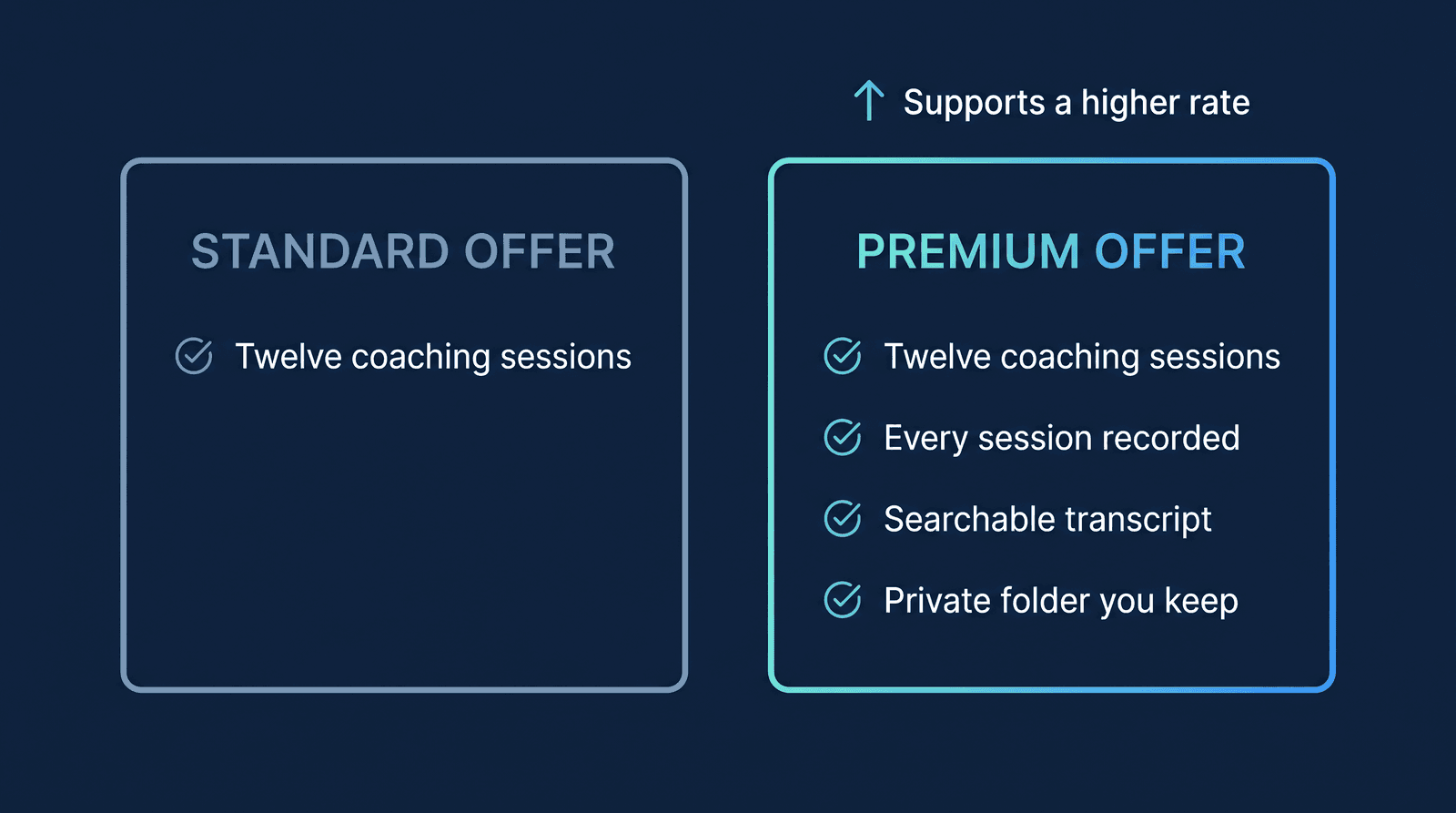
- As the line between tiers. If you sell more than one coaching package, recordings-plus-transcripts is a clean differentiator for the higher tier. The entry package gets the sessions; the premium package gets the sessions and a permanent, searchable library of them. You're charging more for genuinely more, not for an arbitrary gate.
- As a reason to raise — or hold — your rate. Concrete added value works in both directions: it gives you something to point to when you set a higher number, and something to defend when a prospect pushes back. The move that quietly erodes a coaching business is discounting — a recorded, transcribed, well-organized session archive lets you do the opposite: raise your rate because you're genuinely offering more, instead of knocking a few hundred dollars off to close.
What makes this a margin decision and not just a marketing one is that the cost of delivering it approaches zero — once it's automatic. If recording and filing every session is a manual chore (download the file before it expires, rename it, move it to the right client folder, share it), then your "premium inclusion" is really unpaid admin you've promised to do every week, and it's the first thing to slip during a busy stretch. A deliverable you have to remember isn't a deliverable; it's a liability. The economics only work when the artifact produces itself.
How RecordFlow fits
That's the gap RecordFlow closes. Setup is a one-time, roughly 60-second connection — sign in with Zoom, connect Google Drive, choose a folder. After that, the moment a Zoom cloud recording is ready, RecordFlow copies the files — the video, the audio-only file, the chat log, and the transcript — into a Google Drive folder you own: one folder per meeting, named with the date and the meeting topic, grouped by year. The files move straight from Zoom to your Drive; RecordFlow never keeps a copy on its own servers, which matters when the session was confidential. (The full mechanics are in the pillar guide on backing up Zoom recordings to Drive.)
Two details make the deliverable feel premium rather than like a raw file dump. Alongside the recording, RecordFlow uploads a clean Google Doc transcript — the raw caption file reformatted into readable, timestamped paragraphs with each speaker named — so the client receives a searchable document, not a wall of caption fragments. And because the folder is yours, you share it on your terms with a Drive link the client already knows how to open; Drive's per-recipient sharing keeps each client's library private to that client. The premium inclusion you named on your sales page then gets delivered every session, without you touching it.
The work you do in a coaching session is the same whether or not it's recorded. What changes is what the client walks away holding — and what you can credibly put on the page when you name your price. The artifact was there in the call all along. You were just letting it evaporate the moment the call ended.
Make 'recorded and delivered' part of what you sell.
Connect Zoom and Google Drive once, and every session is recorded, transcribed, and filed in a folder you own — automatically, at no cost per call. Video, audio, and a clean transcript Doc, ready to be the premium inclusion on your sales page. Free during beta.